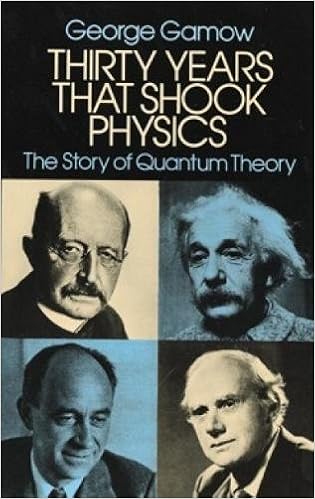
Another great story from George Gamow. I read his book Gravity and I highly recommend reading that one too. He has an exceptional talent in simplifying complicated topics. In this book, where he summarizes the development of quantum theory, he has a very similar writing style. He explains very complex physical theories such as uncertainty, de Broglie waves, Pauli exclusion principle etc. incredibly simple for a layperson. But, somehow he manages to give much more helpful information about them than any textbook that I read can give. If I were to teach chemistry, this book would be a class assignment for my students in their first semester.

Posts from an inorganic chemistry enthusiast!
Showing posts with label atomic theories. Show all posts
Showing posts with label atomic theories. Show all posts
Friday, July 7, 2017

Sunday, December 28, 2014
Book : Memoirs by Edward Teller
No matter what people say about him, Edward Teller is one of my science heroes. I don't care about his personal life or some of his "controversial" ideas. I care about his approach to science and research. He was a great mind and truly a genius.
His Memoirs is a really long (602 pages) but a fun to read autobiography. The story of his life is also the story of science (nuclear physics/chemistry) that covers almost a century. I think you should read the book even though you don't like anything about him. There are tens of stories, memories, people that you will find interesting to learn about.

I really enjoyed his Memoirs and took some notes. I will quote a few of them here (as always I do not agree with him or others on everything they said):
His Memoirs is a really long (602 pages) but a fun to read autobiography. The story of his life is also the story of science (nuclear physics/chemistry) that covers almost a century. I think you should read the book even though you don't like anything about him. There are tens of stories, memories, people that you will find interesting to learn about.
I really enjoyed his Memoirs and took some notes. I will quote a few of them here (as always I do not agree with him or others on everything they said):
"Before I was ten, I understood that in the United States foreigners are not foreign."
"Nationalism has little to contribute today except further suffering."
"Ignore teasing."
"...before the 1880s, science played almost no role in the advances of technology...Chemistry was the first science to undergo a merger with technology, and the first technology affected was dyemaking."
"He [Heisenberg] complained that physics had ceased to develop; there was hardly anything interesting left to do."
"Bohr:Where we find a paradox, we find something of real interest."
"Bohr said that to be properly understood, one should not lecture in his native tongue."
"The lesson is that the correct theory applied to the wrong data is better than no theory applied to correct measurements."
"[Bohr] Opennes is the basic condition necessary for science."
" Johnny [von Neumann] was the Euclid of quantum mechanics."
"The scientist is not responsible for the laws of nature. It is his job to find out how these laws operate...Hydrogen bombs will not produce themselves."
"Science historically had moved forward because of openness."
"I find the idea of civil disobedience in a democracy wrong."
"Fermi and I both lacked formal religious beliefs"
"I believe that if a mentally superhuman race ever develops, its members will resemble Johnny von Neumann."
"I had begun teaching Paul[his son] relativity theory when he was five or six...he understood the theory of relativity by the time he was twelve."
[about Plato's Republic]" I was shocked that a book advocating a centralized government administered from above, much on the lines of totalitarianism, was so highly recommended to young people."
Tuesday, January 21, 2014
Interview with Edward Keller
Many people think that certain scientists are/were "evil." Or you might have heard that some brilliant people led the world to catastrophes etc. Anyway, I don't like to discuss these issues since they tend to end up in hot and undesired discussions. But, please watch this interview with Edward Teller and listen to his really interesting ideas about science/technology, scientists and ethics in general.
Saturday, January 4, 2014

Subscribe to:
Posts (Atom)