Showing posts with label spectroscopy. Show all posts

Friday, July 7, 2017

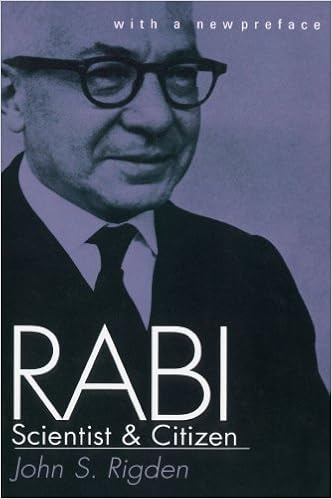
Book: Rabi, Scientist and Citizen

I may be wrong but Rabi I think is one of the least known scientists even though he was one of the most important ones in the 20th century. He won the Nobel Prize for his discovery of nuclear magnetic resonance! In this book, you can find out how difficult it was do study the magnetic resonance in those years with the instrumentation they had. I still can't believe that people built their own instruments, came up with theories/techniques/experiments and did precise measurements! Because the book was written when he was alive and with his collaboration, there are lots of quotes from him. I will compile my notes and paste them here soon.


Friday, November 27, 2015

Bis(dicarbonyl-pi-cyclopentadienyliron)-A Solid-State Vibrational Spectroscopic Lesson #chempaperaday 253

I have highlighted J. Labinger's paper on cyclopentadienyl iron dicarbonyl dimer before. Today's read is a Journal of Chemical Education article focusing on Raman and IR spectroscopy of this dimer. I guess its main purpose is to show how useful these techniques are, but how difficult it is to determine a structure based on spectroscopy (especially for this dimer). I was actually just reading another paper on this dimer like 5 minutes ago. I'll probably post it soon.


I always think about Raman spectroscopy as some sort of esoteric technique. You always hear about it, read about it; but never see it. Certainly I haven't. We don't even have the instrument in the department. 

I like this paper because there is enough spectra and discussion about both IR and Raman spectroscopy of the dimer. You can also see a nice symmetry treatment and finding the IR and Raman active bands of the two isomers.

Thursday, October 29, 2015

Characterization of an Fe≡N–NH2 Intermediate Relevant to Catalytic N2 Reduction to NH3 #chempaperaday 240

The first of the series of papers I will post from Peters lab this week. I absolutely love their projects and synthetic work.


In this paper, they used several spectroscopic techniques to identify an important intermediate and it was determined that the complex is "a doubly protonated hydrazido(2−) complex featuring an Fe-to-N triple bond." The structure and bonding probably similar to an intermediate in O2 reduction by Fe.

http://pubs.acs.org/doi/abs/10.1021/jacs.5b03432

Wednesday, January 28, 2015

Alfred Werner's seminal 1910 paper on polynuclear cobalt complexes: What have we learnt since then?

Alfred Werner is one of my heroes in chemistry. He's probably in top 3 with Linus Pauling and Fritz Haber. I wrote posts about him before. Also here are two links about the controversy between him and Jorgensen:


But, he has some role on almost anything I write about inorganic chemistry since he is the founder of coordination chemistry and probably the most important chemist who showed people the importance and power of inorganic chemistry. What he did in his limited time (he died at the age of 53) and with his limited equipment is simply incredible. He left us hundreds of pages of publications, books and his legend. 

Karl Wieghardt is among my scientific heroes and as I said before I hope I can work for him one day. Here is an interview with him that I posted before. So, I am extremely happy to hear him giving a talk about Alfred Werner. I will not spoil it for you, because I really want you to watch/listen to this presentation by him about Alfred Werner. Once again, I hope you will realize and share my thoughts about Alfred Werner. Because, as Werner's life, the presentation is also full of surprises. I am pretty sure you will learn many things about Werner that you haven't heard so far. I hope you enjoy it.

Wednesday, November 5, 2014

"Fitting the Pieces of the Puzzle: The δ Bond" #chempaperaday 99

Multiple bonds between metal atoms! My favorite! I am in love with them since I've seen the first structure and molecular orbital diagram of [Re2Cl8]2-. I think there is nothing more amazing than having multiple bonds between two metals.


This is a "Viewpoint" and it's written for the "50th anniversary of the first paper describing a species with a quadruple bond by a team led by F. A. Cotton..."

It's not only a good summary of great work by him and his students, but also a great text full of hints how and with which instrumentation you should approach problems in your research.


http://pubs.acs.org/doi/abs/10.1021%2Fic500119h


Wednesday, July 16, 2014

#chempaperaday Day 36/365 : "Ligand Field Theory"

This is a great introduction and mostly qualitative explanation of Ligand Field Theory(LFT) written by F.A.Cotton for undergraduate students. 

Even if you are sure that you know everything about LFT, I still suggest that you should read it. It's a very simple but effective explanation.

Monday, May 12, 2014

Book: "Chemical Applications of Group Theory"

If you have ever read SOMETHING in Inorganic Chemistry, I am sure you have heard of F. Albert Cotton! So, apart from countless publications and other textbooks, he wrote this book to help chemists understand group theory and use it. 

The importance of this book can easily be understood by the preface:

"Despite the fact that there seems to be a growing desire among chemists at large to acquire this knowledge, it is still true that only a very few, other than professional theoreticians, have done so...no book available which is not likely to strike some terror into the hearts of all but those with an innate love of apparently esoteric theory."


I tried to buy the first edition of this book (1963) and I did. Because, I think it has historical importance too.


Book: "Symmetry and Spectroscopy: An Introduction to Vibrational and Electronic Spectroscopy"

I read and studied this book when I was taking Advanced Inorganic Chemistry. I found it incredibly useful and helpful. To be honest, I used it more than I used my textbook. Not that the textbook was not well written, but because this book is so well organized and practical. 


The book starts with symmetry, symmetry elements/operations and point groups. In the end of this chapter, you start to learn matrix representation of those operations and learn how to use character tables. 

The second chapter gives very brief information on quantum mechanics. The authors really did great job to keep it as simple and useful for students. So, don't panic. You can easily understand this chapter as long as you are comfortable with calculus. On a side note, I should mention that EVERYONE should learn calculus.

The third chapter is about Vibrational Spectroscopy and the application of Group Theory. You can see how symmetry is used in spectroscopy. I promised to do some practice problems here on the blog and I am sorry I failed to do so. But, I will keep my word as soon as possible.

The next chapter is MO Theory and the last chapter is about Electronic Spectroscopy. I loved these two chapters because you can really learn how symmetry is used to interpret spectra and data. Textbooks have similar problems too. But, what makes this book special is that everything is explained in more detail and the practice and chapter problems are from REAL publications. I think this book really pushes you to read publications. You can see how EACH vibration of para-difluorobenzene is assigned to  an orbital!

I think anyone who is interested in Inorganic Chemistry, Physical Chemistry and spectroscopy should read this book.