Showing posts with label physics. Show all posts

Friday, July 7, 2017

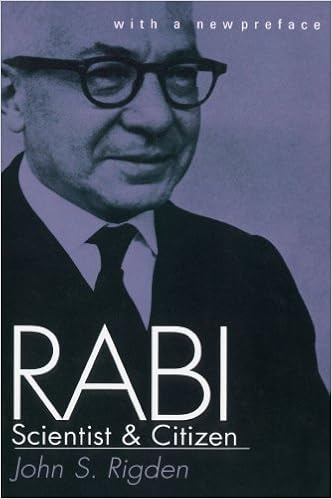
Book: Rabi, Scientist and Citizen

I may be wrong but Rabi I think is one of the least known scientists even though he was one of the most important ones in the 20th century. He won the Nobel Prize for his discovery of nuclear magnetic resonance! In this book, you can find out how difficult it was do study the magnetic resonance in those years with the instrumentation they had. I still can't believe that people built their own instruments, came up with theories/techniques/experiments and did precise measurements! Because the book was written when he was alive and with his collaboration, there are lots of quotes from him. I will compile my notes and paste them here soon.


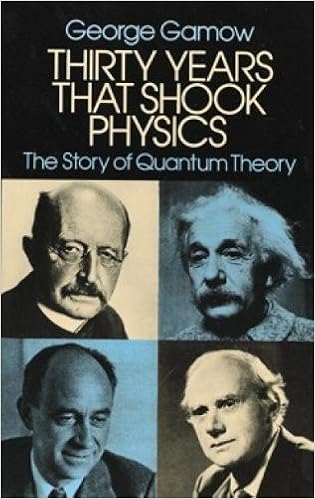
Book: Thirty Years that Shook Physics: The Story of Quantum Theory

Another great story from George Gamow. I read his book Gravity and I highly recommend reading that one too. He has an exceptional talent in simplifying complicated topics. In this book, where he summarizes the development of quantum theory, he has a very similar writing style. He explains very complex physical theories such as uncertainty, de Broglie waves, Pauli exclusion principle etc. incredibly simple for a layperson. But, somehow he manages to give much more helpful information about them than any textbook that I read can give. If I were to teach chemistry, this book would be a class assignment for my students in their first semester.

Monday, February 8, 2016

Book: Half-Life: The Divided Life of Bruno Pontecorvo, Physicist or Spy

I believe most of us who are not physicists or who are not much interested in physics have never heard of Bruno Pontecorvo's name. The moment I saw the title of the book, I fell in love with it and had this strong urge to read it. As a science books enthusiast, I consider myself a knowledgeable person when it comes to names of scientists and their accomplishments. But, there I was, standing in front of this book and had no idea who he was. 


Bruno Pontecorvo was an Italian physicist whose academic advisor was Enrico Fermi! Although he didn't excel in his informal examination with Enrico Fermi, he was accepted to join Fermi's team that was later known as Via Panisperna Boys as an experimental physicist. In fact, at the age of 21 he published his first paper with Fermi. Here he witnessed the first use of slow-neutron technique and became one of the names on the patent of this technology. Around this time, he became an active supporter of communism. The atmosphere being very dangerous for Jews, he fled Italy and joined Irene Curie and Frederic Joliot's research team. Later in 1940, he had to escape Europe to start his new job as an oil inspector in the US. He started to use neutrons to locate oil-rich terrains which would have made him a millionaire had he patented it as he confesses. In 1943, he joined the researchers at Chalk River to work on the nuclear projects there. By the end of the 2nd World War, he started to focus his research on neutrinos and how to capture them and moved to Britain in 1949 to work at Harwell. Here at Harwell, his ties to communism and previous suspicions about him caused a lot of trouble. Finally, in September 1950, Bruno and his family disappeared in Helsinki. It was 5 years later that the world heard of him. He was in Soviet Union working in Dubna. 

Frank Close did a wonderful job in combining Bruno Pontecorvo's science and his life. He gives enough information and background about the other names that are relevant to Bruno's story which is really helpful. We still don't know if he was a spy or not, but his contributions to physics is very clear. There have been a few Nobel Prizes in Physics  that he would have easily won. Unfortunately, being in Soviet Union, isolated and having limited access to modern equipment caused the Nobel committee not to recognize his work. This is not only a great life story, but also a really good popular science book where you can find technical but simple information about nuclear physics and the history of nuclear physics.

Sunday, February 7, 2016

Book : Selections from The Principle of Relativity

Although I am familiar with Einstein's theories, I have never read anything written by him. Having finished Gravity, I thought it's time to read relativity from his own writings. I have more than one degree in STEM fields (fair to say I am good at math and physics), I don't have experience in reading physics papers though. Here is what I think about the book:

- I think the translation is not good. At first, I thought it's due to the language of physics and the way those papers are written, but later I realized that some sentences are indeed too long and missing pieces. I think it would have been much better if someone divided long sentences into small pieces while maintaining the meaning. I understand we can't really call that translation and the purpose of the book is not to reach everyone, but it would be easier to understand.

- To my surprise, I found Einstein's writings very clear. His thought experiments and the way he simplifies them are incredible. He is like a modern day Socrates building up his logic starting from the simplest assumptions and laws. He is very clear when he doesn't agree with another physicist or a theory. All the conclusions of his papers here are incredibly simple and easy to understand. He really avoids being too complicated as much as he can. 

- I am not studying physics and I don't have interest in using his equations to understand the universe around me, so I skimmed through his equations when he starts to derive the necessary but complicated equations for his work. But, still the general equations are not that complicated. 

- I loved the paper On the Influence of Gravitation on the Propagation of Light. Here how it starts:

In a contribution published four years ago* I tried to answer the question whether the propagation of light is influenced by gravitation. I return to this theme because my previous presentation of the subject does not satisfy me, but even more because I now see that one of the most important consequences of my former treatment is capable of being tested experimentally. For it follows from the theory to be presented here, that light-rays passing close to the sun are detected by its gravitational field so that the apparent angular distance between the sun and a visible fixed star near to it is increased by nearly a second of arc.
 I think it is one that I fully understood.

Overall, I think anyone who believes that he can understand university level physics and math should read this book. If you have time, there are tons of resources online where these papers are sort of "annotated" and are explained by other scientists. So, in a few weeks, you can easily fully grasp what a true genius Einstein was.  Like I said, my purpose was just to read his writings and his theories by his own words. I think I was able understand what he's trying to say. I am sure someone who is a physical chemist or physicist will fully grasp all the math behind the theories since he derives them one by one.

I don't think we'll ever have another Einstein.