Showing posts with label physical chemistry. Show all posts

Friday, July 7, 2017

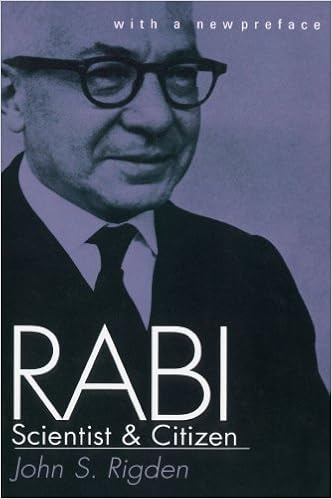
Book: Rabi, Scientist and Citizen

I may be wrong but Rabi I think is one of the least known scientists even though he was one of the most important ones in the 20th century. He won the Nobel Prize for his discovery of nuclear magnetic resonance! In this book, you can find out how difficult it was do study the magnetic resonance in those years with the instrumentation they had. I still can't believe that people built their own instruments, came up with theories/techniques/experiments and did precise measurements! Because the book was written when he was alive and with his collaboration, there are lots of quotes from him. I will compile my notes and paste them here soon.


Monday, November 30, 2015

Syngas in perspective #chempaperaday 255

Closely related with the previous post, I wanted to highlight this paper too. This one is a little bit more technical. It covers the conversion of natural gas into Fischer-Tropsch products and how the manufacturing costs affect the process.

Thursday, October 8, 2015

Why Combustions Are Always Exothermic ? #chempaperaday 235

A very simple question, but incredibly hard to answer without thinking about it. In fact, I don't think I can give a correct answer without looking up. Even then, I would probably be wrong. Luckily, this great article will help me in the future. It gives enough evidence and answers simple questions like "why fire is hot regardless of the fuel" and "why in spite of its high bond enthalpy, O2 is abundantly present in our atmosphere.?"


I printed this article and I will keep it as a reference and educational source for my own purposes.

Sunday, October 4, 2015

Oxidation State, A Long-Standing Issue! #chempaperaday 234

Oxidation state is both the simplest and the hardest concepts of chemistry. To be honest, sometimes (maybe more often than sometimes), I get confused too.  In fact, you can even find slightly different definitions of oxidation state depending on what you are trying to reach in the end. To be honest, I found this paper a little bit confusing in the beginning. It's not the author's fault of course. Once again, oxidation state is not really straightforward. Overall, I think it is a nice paper to read and a good summary of interesting examples.

BONUS : It's open access.


http://onlinelibrary.wiley.com/doi/10.1002/anie.201407561/abstract

Friday, May 22, 2015

Walther Nernst and the Development of Physical Chemistry #chempaper 217

A fantastic article about a great physical chemist Walther Nernst by Gerhard Ertl for those who are interested in history of chemistry and chemists. I mentioned that Nernst and Fritz Haber had a dispute over ammonia synthesis. Here you can read it again:

"Fritz Haber, who in actual fact owed this success to the controversy with Walther Nernst, was awarded the Nobel Prize in 1918 for this,while Nernst in 1916 in aletter to BASF wrote:“unfortunately Ithen held the view that it is technically difficult to make”."

Wednesday, January 28, 2015

Alfred Werner's seminal 1910 paper on polynuclear cobalt complexes: What have we learnt since then?

Alfred Werner is one of my heroes in chemistry. He's probably in top 3 with Linus Pauling and Fritz Haber. I wrote posts about him before. Also here are two links about the controversy between him and Jorgensen:


But, he has some role on almost anything I write about inorganic chemistry since he is the founder of coordination chemistry and probably the most important chemist who showed people the importance and power of inorganic chemistry. What he did in his limited time (he died at the age of 53) and with his limited equipment is simply incredible. He left us hundreds of pages of publications, books and his legend. 

Karl Wieghardt is among my scientific heroes and as I said before I hope I can work for him one day. Here is an interview with him that I posted before. So, I am extremely happy to hear him giving a talk about Alfred Werner. I will not spoil it for you, because I really want you to watch/listen to this presentation by him about Alfred Werner. Once again, I hope you will realize and share my thoughts about Alfred Werner. Because, as Werner's life, the presentation is also full of surprises. I am pretty sure you will learn many things about Werner that you haven't heard so far. I hope you enjoy it.

Monday, May 12, 2014

Book: "Symmetry and Spectroscopy: An Introduction to Vibrational and Electronic Spectroscopy"

I read and studied this book when I was taking Advanced Inorganic Chemistry. I found it incredibly useful and helpful. To be honest, I used it more than I used my textbook. Not that the textbook was not well written, but because this book is so well organized and practical. 


The book starts with symmetry, symmetry elements/operations and point groups. In the end of this chapter, you start to learn matrix representation of those operations and learn how to use character tables. 

The second chapter gives very brief information on quantum mechanics. The authors really did great job to keep it as simple and useful for students. So, don't panic. You can easily understand this chapter as long as you are comfortable with calculus. On a side note, I should mention that EVERYONE should learn calculus.

The third chapter is about Vibrational Spectroscopy and the application of Group Theory. You can see how symmetry is used in spectroscopy. I promised to do some practice problems here on the blog and I am sorry I failed to do so. But, I will keep my word as soon as possible.

The next chapter is MO Theory and the last chapter is about Electronic Spectroscopy. I loved these two chapters because you can really learn how symmetry is used to interpret spectra and data. Textbooks have similar problems too. But, what makes this book special is that everything is explained in more detail and the practice and chapter problems are from REAL publications. I think this book really pushes you to read publications. You can see how EACH vibration of para-difluorobenzene is assigned to  an orbital!

I think anyone who is interested in Inorganic Chemistry, Physical Chemistry and spectroscopy should read this book.