Showing posts with label scientists. Show all posts

Friday, July 7, 2017

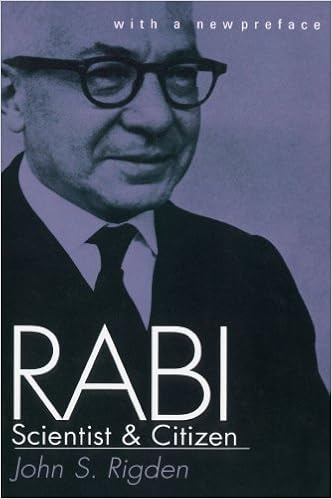
Book: Rabi, Scientist and Citizen

I may be wrong but Rabi I think is one of the least known scientists even though he was one of the most important ones in the 20th century. He won the Nobel Prize for his discovery of nuclear magnetic resonance! In this book, you can find out how difficult it was do study the magnetic resonance in those years with the instrumentation they had. I still can't believe that people built their own instruments, came up with theories/techniques/experiments and did precise measurements! Because the book was written when he was alive and with his collaboration, there are lots of quotes from him. I will compile my notes and paste them here soon.


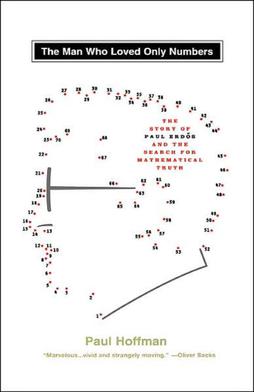
Book: The Man Who Loved Only Numbers: The Story of Paul Erdős and the Search for Mathematical Truth

The biography of Paul Erdos. Such an interesting genius. He didn't own much. He traveled all around the world to give lectures, solve problems and offer prizes for some really difficult problems in math. You can tell that he dedicated all his life to math only.

It was an easy read and I enjoyed reading it.

https://upload.wikimedia.org/wikipedia/en/d/d3/Man_who_loved_only_numbers_bookcover.jpg 


Monday, June 26, 2017

Roald Hoffmann #chempaperaday 304

A real genius. I was aware of his research even before grad school, but I never read them. I thought they were pure theoretical papers and I would understand nothing. Then for one of my Ph.D. requirements, I did some literature search on metal carbonyls and I started to read his fantastic work on molecular orbitals. One after one, I realized that his papers are much better than any inorganic chemistry textbook you have. His explanation, analogies, examples and the way his mind works to explain orbital interactions is incredible. I enjoyed all of them and didn't stop there. We definitely need more Hoffmann like chemists.

He says "My greatest achievement has been teaching four generations of chemists how to use molecular orbitals in their thinking." and I think he is right. There is noone out there that can teach it better than him. Just pull a paper of his on MO's and you will agree with me.

I was lucky enough to meet him this year. He is such an amazing person and full of life.

Thursday, March 10, 2016

Charles Darwin - not a genius?

A few weeks ago, we had to evacuate the department for some reason. As I was hanging around some old Science magazines, I found the Jan. 9, 2009 issue. It appears that it's a special issue dedicated to Charles Darwin and his famous book. I read several articles in this issue and I'm glad we evacuated the department.

Recently, I saw this ridiculous article "Charles Darwin was no 'heroic genius', say scientists". Thanks to modern day "science journalists", it was hard to find the original research article. Anyway, I was able to find the paper with some digging. I am not planning to read the paper since I have better and more useful things to do. Assuming that they do claim that Charles Darwin was not a genius and he was just someone who followed up a popular idea of his time, I am flat out going to say that I disagree. This brings us to the Science magazine I mentioned above. Please take a few minutes and read why he was special. Thanks to Peter J. Bowler there is an article in this issue with the title "Darwin's Originality". You'll find the answers you need there. I hope Dr. Michael Muthukrishna (the lead author of the claim above) who is I guess a psychologist will find some time to read this article and hopefully change his mind. Here is what he said to Telegraph :

"We can see this process at work when two people have the same apparently innovative idea at the same time – such as Charles Darwin and Alfred Wallace with the theory of natural selection."
Rather than being heroic geniuses, Darwin and Wallace were in the same ‘cultural milieu’, both reading the same books and both travelling to biologically diverse island environments.”  

Looks like it's that simple for Dr.Muthukrishna. Ridiculous.

Monday, February 8, 2016

Social media and science

I rarely write anything on "controversial" topics. A few days ago, I saw this interview was mentioned here and there. I usually don't read young scientists' interviews since I don't think I can learn much from them. How much experience they have anyway? Let's see what people especially didn't like about this interview:

- Do you think there is an increased need for scientists to market themselves and their science as a brand? 
I think the idea that scientists need to operate more like a business is becoming a major problem in science recently. There is science and there is business — they are different and should be fundamentally driven by different goals: one, the pure and unadulterated desire for greater knowledge and the other, monetary gain. Branding science puts focus on making your research appealing, which is extremely limiting, and — dare I say? — corrupts the scientifi c process. There is a lot of fundamental research that needs to be conducted that is not ‘sexy’. Such ‘science branding’ has not yet affected the Chinese Academy of Sciences and for that I’m grateful.

- What’s your view on social media and science?
For example, the role of science blogs in critiquing published papers? Those who can, publish. Those who can’t, blog. I understand that blogs can be useful in affording the general public insights into current science, but it often seems those who criticize or spend large amounts of time blogging are also those who don’t generate much publications themselves. If there were any valid criticisms to be made, the correct venue for these comments would be in a similar, peer-reviewed and citable published form. The internet is unchecked and the public often forgets that. They forget or are unaware that a published paper passed rigorous review by experts, which carries more validity than the opinion of some disgruntled scientist or amateur on the internet. Thus, I find that criticism in social media is damaging to science, as it is to most aspects of our culture.

I completely agree with the first paragraph. At least for me, fundamental science is much more important than anything that you can think of (money, fame, 10000 followers etc.). People who know me in real life witness this pretty much every day. It's also clear that some people use social media to market their names and research. While I understand most of the reasons, I don't accept it.

When it comes to second paragraph, I can't say I totally agree. Yes, it's true there are a lot of people whose sole purpose is to criticize ANYONE and they usually do this as a group of like minded "scientists." But, if I were the scientist being criticized, I'd just ignore and let them talk. Would I ever answer? No. So, I think scientists shouldn't care what others say about them. After all, "What Do You Care What Other People Think?"

Finally, it's partly true that "Those who can, publish. Those who can’t, blog." I applaud Jingmai O’Connor for being honest. We need more people like her who can say what they think.


Book: Half-Life: The Divided Life of Bruno Pontecorvo, Physicist or Spy

I believe most of us who are not physicists or who are not much interested in physics have never heard of Bruno Pontecorvo's name. The moment I saw the title of the book, I fell in love with it and had this strong urge to read it. As a science books enthusiast, I consider myself a knowledgeable person when it comes to names of scientists and their accomplishments. But, there I was, standing in front of this book and had no idea who he was. 


Bruno Pontecorvo was an Italian physicist whose academic advisor was Enrico Fermi! Although he didn't excel in his informal examination with Enrico Fermi, he was accepted to join Fermi's team that was later known as Via Panisperna Boys as an experimental physicist. In fact, at the age of 21 he published his first paper with Fermi. Here he witnessed the first use of slow-neutron technique and became one of the names on the patent of this technology. Around this time, he became an active supporter of communism. The atmosphere being very dangerous for Jews, he fled Italy and joined Irene Curie and Frederic Joliot's research team. Later in 1940, he had to escape Europe to start his new job as an oil inspector in the US. He started to use neutrons to locate oil-rich terrains which would have made him a millionaire had he patented it as he confesses. In 1943, he joined the researchers at Chalk River to work on the nuclear projects there. By the end of the 2nd World War, he started to focus his research on neutrinos and how to capture them and moved to Britain in 1949 to work at Harwell. Here at Harwell, his ties to communism and previous suspicions about him caused a lot of trouble. Finally, in September 1950, Bruno and his family disappeared in Helsinki. It was 5 years later that the world heard of him. He was in Soviet Union working in Dubna. 

Frank Close did a wonderful job in combining Bruno Pontecorvo's science and his life. He gives enough information and background about the other names that are relevant to Bruno's story which is really helpful. We still don't know if he was a spy or not, but his contributions to physics is very clear. There have been a few Nobel Prizes in Physics  that he would have easily won. Unfortunately, being in Soviet Union, isolated and having limited access to modern equipment caused the Nobel committee not to recognize his work. This is not only a great life story, but also a really good popular science book where you can find technical but simple information about nuclear physics and the history of nuclear physics.

Sunday, February 7, 2016

Book : Selections from The Principle of Relativity

Although I am familiar with Einstein's theories, I have never read anything written by him. Having finished Gravity, I thought it's time to read relativity from his own writings. I have more than one degree in STEM fields (fair to say I am good at math and physics), I don't have experience in reading physics papers though. Here is what I think about the book:

- I think the translation is not good. At first, I thought it's due to the language of physics and the way those papers are written, but later I realized that some sentences are indeed too long and missing pieces. I think it would have been much better if someone divided long sentences into small pieces while maintaining the meaning. I understand we can't really call that translation and the purpose of the book is not to reach everyone, but it would be easier to understand.

- To my surprise, I found Einstein's writings very clear. His thought experiments and the way he simplifies them are incredible. He is like a modern day Socrates building up his logic starting from the simplest assumptions and laws. He is very clear when he doesn't agree with another physicist or a theory. All the conclusions of his papers here are incredibly simple and easy to understand. He really avoids being too complicated as much as he can. 

- I am not studying physics and I don't have interest in using his equations to understand the universe around me, so I skimmed through his equations when he starts to derive the necessary but complicated equations for his work. But, still the general equations are not that complicated. 

- I loved the paper On the Influence of Gravitation on the Propagation of Light. Here how it starts:

In a contribution published four years ago* I tried to answer the question whether the propagation of light is influenced by gravitation. I return to this theme because my previous presentation of the subject does not satisfy me, but even more because I now see that one of the most important consequences of my former treatment is capable of being tested experimentally. For it follows from the theory to be presented here, that light-rays passing close to the sun are detected by its gravitational field so that the apparent angular distance between the sun and a visible fixed star near to it is increased by nearly a second of arc.
 I think it is one that I fully understood.

Overall, I think anyone who believes that he can understand university level physics and math should read this book. If you have time, there are tons of resources online where these papers are sort of "annotated" and are explained by other scientists. So, in a few weeks, you can easily fully grasp what a true genius Einstein was.  Like I said, my purpose was just to read his writings and his theories by his own words. I think I was able understand what he's trying to say. I am sure someone who is a physical chemist or physicist will fully grasp all the math behind the theories since he derives them one by one.

I don't think we'll ever have another Einstein.

Sunday, November 29, 2015

Energy from Heaven and Earth - Book

I am behind in book reviews here. I have finished this book a few months ago but never got the chance to write my thoughts about it. 

The book is actually a collection of Edward Teller's 1975 lectures. He gave a series of lectures as a part of his Harvey Prize requirement.

The dedication on the first page actually was a big surprise to me. Teller dedicated the book to N. A. Rockfeller saying that "..whose vision and initiative, had they only been followed, would have made this book unnecessary." 

There are 5 "parts" in the book each of which consists of several chapters. I really like the way the chapters are arranged. They follow a nice logic: from simple to difficult; from past to future. 

In these chapters, especially in the beginning, you can get a nice summary of how the universe started and the origin of energy. I don't think it's too technical. I believe anyone can easily understand the nuclear reactions and how they yield energy with Teller's excellent explanations. 

If you follow the news and read a little bit of science, people constantly talk about global warming, record CO2 levels etc. I believe this book will help you to ask more scientific questions and evaluate the data and plans in a more scientific way. Should we focus on environment first or on improving our living standards? Can we get enough energy from sun, wind, waves? Ethics vs. science? You can find some clues to these dilemmas. I have to say I am with Teller on many issues.

I strongly suggest people read this book. Even though it was written in 1980, it is still much more relevant to 2015 than many more "popular" scientists' thoughts. 

It is also interesting to read his thoughts on bacteria that converts biomass into fuel, solar cells and devices like photoelectric cells. 

Some quotes:

In a peculiar way I am indebted to the antinuclear forces that staged the great nuclear debate of 1976 in California. Confucius said that if you walk between a wise man and a foolish one, you should learn from both.
I do not advocate a nuclear option. I believe that nuclear energy is an important component of the solution.

The next ice age may well arrive in five thousand years, unless technology finds a way to prevent it.

In the beginning there was matter and heat but no usable energy.

Geothermal energy....this source is no more abundant than coal. We may exhaust it in a few centuries.

Gloomy stories we may hear about out dying planet are most likely wrong.

How do living plants turn into fossil fuels? I have gone to the best geologists and the best petroleum researchers, and I can give you the authoritative answer: no one knows.

Environmentalists may take notice that small is not necessarily beautiful or clean.

Arabs reputedly cannot agree with anybody, least of all with other Arabs.

If one wastes energy, one should pay for it.

California is the most ultra-American of all American states. California's waste is prodigious. 

Electricity ...the most expensive form of energy.

Minimizing energy input is not the main purpose of industry.

It has been remarked that Moses managed to find the only spot in the Middle East where there is no oil.

In today's climate opinion, to be big is to be unpopular.

King Coal has lost his throne to the Sheikhs of Araby.

..a coal-burning electric generating station is apt to emit more radioactivity than a corresponding nuclear plant.

[about CO2] there is possibly not enough oil in the world to make a real difference.

Szilard told me "I found the neutrons"

The alchemists proved that secret science is no science. In the long run we cannot keep secrets, and we should not try.

If scientists consider themselves an elite with responsibility for the world resting on their shoulders, they will no longer be scientists.

The scientist's prime responsibility is scientific knowledge. The scientist's second responsibility is to turn knowledge into practical applications. Finally, the scientist should explain his findings so that everyone can understand. The nonscientific world then can choose to use or misuse the new knowledge.

Best earthquake experts in the US. are found among the members of Jesuit order.

To prophets of the apocalypse, reactors are precursors of the end of the world.

It seems that even in California the nuts are in a minority.

We have not yet gotten to the point where we are willing to sacrifice a tourist attraction to our economic needs.

The very word "patent" means the opposite of secret. But our present patent law is archaic.

Wednesday, November 25, 2015

The Anion of Zeise's Salt #chempaperaday 251

Zeise's Salt is accepted as the first organometallic compound and it was prepared by William Christopher Zeise. Before talking about his life, let's see what this salt is. Apparently, Zeise first prepared this compound in 1825, but it did not draw much attention. In 1830, he publishes a detailed paper on the synthesis and properties of this interesting "brown residue". He does some analytical work in addition to adding KCl to the compound and names the salt as "inflammatory potassium platinum salt". He was one of those early chemists who tastes his compounds and now we know that it tastes as "metallic, astringent, long lasting".

A few years later, he was challenged by the famous Justus Liebig. Liebig doesn't believe the composition of the compound and suggests that it contain oxygen. He believes that the compound has an alkoxy group. Zeise does more analytical work and shows that there is no oxygen but of course Liebig was not convinced and writes a paper in reply to Zeise.

15 years later, Karl Birnbaum repeats Zeise's experiments and determines that his formulation is correct. The crystal structure of Zeise's salt was first solved in 1954 and you can see a representation below. For the untrained person, coordination mode of olefin is really weird. For an inorganic chemist, it is perfectly fine. I will write another post on the bonding and molecular orbital diagram of this compound soon, so I am moving on to Zeise's life now.

To be honest, I only knew Zeise by his famous compound. To my surprise, he turned out to be one of the greatest chemists ever! His research was focused on chemistry of sulfur and he discovered xanthates and thiols! He also tried to study components of tobacco smoke!


It turns out he did most of his experiments at home and his cats were killed by his landlord due to a terrible smell. In fact, he was even removed from a play because he smelled so bad.

What a character, what a chemist. This short but fantastic article really urged me to read more about Zeise. I've just started to collect some papers now.

* all images are from wikipedia pages for Zeise's salt and Zeise himself.

Thursday, June 25, 2015

Multiple Metal-Metal Bonds #chempaper 224

This is another paper by F.A. Cotton on (of course) multiple metal-metal bonds. It was basically a lecture he gave in ACS Seattle (1983). Not surprisingly he summarizes multiple M-M bonding starting as early as mid 18th century. So, I got to learn a lot from this paper that I had not known. There is also a really interesting quote and talk by Linus Pauling on metal-metal bonding where he tries to describe a few Mo-Mo, W-W and Ta-Ta bonds. Cotton also confesses that he had heard about Pauling's paper by pure coincidence.

On the famous Re-Re multiple bonding, Cotton says :

As always, it was a pleasure to read the paper. I hope you enjoy it too.

Friday, May 29, 2015

A Career in Catalysis: John E. Bercaw #chempaper 221

This is a great "Account" highlighting John Bercaw's career and success. If you are in inorganic chemistry, it is very often that you will see his papers cited or his work is mentioned in many papers. If you are doing organometallic work, you will always find some help in his work. 

Thursday, April 23, 2015

Book: The Kaiser's Chemists: Science and Modernization in Imperial Germany

This book is a great source on the history of chemistry and its relation with politics, governments and of course war. 


By the end of the 19th century, some German chemists (Emil Fischer -"a pillar of militarized science" in particular) started to think that they were losing their position in chemistry (especially in inorganic chemistry) to the US. "We must do more for inorganic and general chemistry again, if we are not to be put to shame by other countries."
 
Fischer and several other chemists decided to convince the Kaiser to fund chemistry and open new labs. What they had in mind was a large research facility with the most modern equipment. So, it took years and a lot of PR to convince companies and the Kaiser himself to open these research centers. Not surprisingly for those years, about half of the funding came from Jewish businessmen (you can read the reasons in the book). These centers, in turn, brought much success to Germany and tens of Nobel Prize winners. 


The best part of the book in my opinion is that it allows you read the discussions among academicians and politicians regarding the importance of funding, research ideas and commercial applications of the products. Just like today, many chemists believed that chemistry was no longer a career or how little chemists were respected. There were also fights among several professors on why there were few positions (or too many chemists). On the other hand, there were chemists telling that there were too many professors at upper ranks. Professors complaining about teaching duties... Basically, everything was exactly the same as today.

There are also so many details that I didn't know about such as the rivalry between Nernst and Haber, Willstatter's research interest in photosynthesis in the living leaf, Einstein's pacifist letter with only 4 signatures and Fischer's wish for Haber's tests "failure from the bottom of my patriotic heart"

Some interesting quotes:

"Science did not escape the rise of nationalism but adapted to it.

[Ostwald] it was not frequently claimed that I was no chemist, because I never produced a new substance.

Big science, like big industry, needs operating capital.

Standstill is retreat (Duisberg).

As an Austrian women, a Jew and a physicist, Meitner's presence meant little to the German chemists....with the nonposition of unsalaried "guest".

[A university professor] is freer, because he can replace many assistants by students and doctoral candidates.

[Harnack] our enemies...brought German science and military strength as close together as possible.

[Liebknecht] science and research in uniform have hardly ever done good.

...the war converted him [Ostwald] virtually overnight, to an ultranationalist. "


Sunday, April 5, 2015

Pauling's Left-Handed alpha-Helix #chempaperaday 209

Left-handed alpha-helices are not common. In fact, I was able to find only one example with my limited search attempts although I am sure there are many more. There are stereochemical issues, bond distance and dihedral angle restrictions if nature or  you want to make one of them. So, when I first saw the title, I did not want to believe that Pauling proposed a left-handed alpha-helix. I thought he just made a mistake in one of his books or papers. If you read the paper, you will see that this is not the case. For some reason unknown to us, he drew this helix. As the paper explains, in fact he made an arbitrary assignment to R groups when he first reported "the structure of proteins."


But, as the author explains in detail, he should have known the absolute configuration of the amino acids. In fact, his colleagues at his own department were doing research on the subject. So, he should definitely have known much more about his "incorrect" assignment. You can read the article and learn more about the issue. My own understanding is that he was not in close communication with his faculty members in those years due to the political troubles he had had. Maybe the people who really knew the absolute configuration did not correct him on purpose, or he did not want to be corrected by one of those people who were not on his side when he needed support. But, I don't think he was simply not "interested in the problem of absolute configuration." I think this is contrary what we know about his scientific curiosity and genius.

The author is Jack D. Dunitz who is a giant in his field and you may know his name if you can remember Burgi-Dunitz angle.

Saturday, April 4, 2015

At Least 60 Years of Ferrocene: The Discovery and Rediscovery of the Sandwich Complexes #chempaperaday 207

This is probably one of the most interesting and surprising articles I have read. 


I guess all inorganic/organometallic chemists know (I hope) the story of the discovery of ferrocene and other sandwich complexes. It all starts with Pauson and Kealy's Nature papers on the discovery of an unusually stable compound ("What was this remarkable substance we had made?") and goes on. I will not go into the story. If you want to learn, you should read this paper and many other historical papers on these compounds. Later, it turns out that in fact they were not the first people to discover this compound. Many other people had already seen this complex but they simply did not report it. The compound gets attention from several chemists including Woodward, Fischer and Wilkinson. In fact, the name ferrocene was given by Woodward. Soon, the competition between Fischer and Wilkinson started. They literally divided "the periodic table between them".

This is an incredibly well written story. The most interesting two things for me are the comments of a reviewer and Woodward's comments on the Nobel Prize in Chemistry.

First, the referee writes to Woodward "We have dispatched your communication to the printer but I cannot help feeling that you have been at the hashish again."


Secondly, Woodwards writes to the committee on the Nobel prize saying "...I am sure-committed a grave injustice...Both of these concepts were simply, completely, and entirely mine, and mine alone." wow!

Thursday, April 2, 2015

Book: "Linus Pauling and the Chemistry of Life"

I said it before and I will say it again. Linus Pauling deserved to win 3 unshared Nobel Prices in chemistry. In any field of chemistry, you can see his impact. He's always there.


This book is probably the best biography of Linus Pauling. I opened the book a very late time at night and I just couldn't stop reading it until I finished and I wish it had not finished. Such an amazing storytelling. I knew a lot about his life even before reading the book, but I still learned a lot. I knew he had trouble with government but I did not know that FBI investigated him for 24 years and some of the funding agencies cut his research funding. He had really hard time finding a place to work! What a shame. How unfair! 

There is no other chemist that revolutionized chemistry and medicine as much as he did. He was a true genius and it's a shame that for decades he was alienated by his colleagues and his government.

Sunday, March 8, 2015

Book: The Violinist's Thumb

I got this book as a gift. As I read The Disappearing Spoon by the same author before, I was expecting it would be as entertaining and interesting as it was. I think this is a good book to read, but if you already know some about biology, genetics, genes and some evolution; I don't think you will learn much. I read it quickly and I liked it (3 stars). There are several interesting stories, but in my case, I knew most of them. Anyway, I still think it is worth reading since there are a lot of names and details. Also, you will have a lot to learn if you do not know much about science.


Friday, March 6, 2015

A Salute to My Colleague Yves Chauvin, 1930–2015 #chempaperaday 196

Olefin metathesis is one of the most important and useful chemical transformations. The earliest versions of this reaction involved using not well defined catalysts and the reaction mechanism was not understood. In 1971, Chauvin proposed a mechanism that is accepted as the actual mechanism of the reaction today.

Chauvin died on January 27. I have read about him before. But, I think this is the best article.
Here are a few quotes from him proving how good a scientist he was:

“If you want to find something new, look for something new!”
“Some people say that there is too much chemistry in our society. It is in fact the opposite: there is not enough chemistry, not enough understanding, not enough control of chemical reactions. Catalysis is the key for a better chemistry.”

Friday, February 20, 2015

The German Chemical Society (GDCh) and Nazi Germany #chempaperaday 194


For those interested in history of science and chemistry, this is a short and a good article.

"all sciences and engineering were involved in the planning of the war, but chemistry played a central role; hardly any area of the war effort was able to do without the help of chemistry, for example in the synthesis of gasoline, new polymeric materials, or the availability of explosives.

A simplified summary is that the DChG was a society for (inter)national researchers in academia, whereas the VDCh represented predominantly the German industrial chemists. The leading scientific
journal of the DChG was the Berichteder deutschen Chemischen Gesellschaft, whereas the top-tier journal of the VDCh was Angewandte Chemie."

I am glad to learn that a new book is coming very soon:

Chemiker im “Dritten Reich” –Die Deutsche Chemische Gesellschaft und der Verein Deutscher Chemiker im NS-Herrschaftsapparat


."

Sunday, February 15, 2015

One Hundred Years of the Fritz Haber Institute #chempaperaday 192

Fritz Haber Institute is one of the "sub" institutes of Max Planck Institute. Unless you are interested what they do, you probably have not heard of the institute. Since, I follow some of their research areas, I can say I know a some about the institute and in fact it would be an honor for me to work there one day in the future.

So I was really happy when I came across this paper about a month ago. It's a short history of the institute and the research within covering one hundred years. I am glad I read it because I was able to learn much more than I know about FHI. I did not know FHI had seven Nobel laureates for example.

http://onlinelibrary.wiley.com/doi/10.1002/anie.201104792/abstract

                                                                   Photo: Wikipedia
If you read the paper, you will learn how much the institute contributed to modern science especially in surface chemistry, heterogeneous catalysis and electron microscopy. I would like to highlight a few titles that were also related to FHI: gas masks, methane detector, allotropes of hydrogen, symmetry. 

The fields of research explained by the paper are:

Gas-Phase Kinetics and Dynamics
Methane Detector
Haber-Born Cycle
Chemiluminescence
Combustion
Sttatistical Mechanics
The Franck-Hertz and the Compton Effects
Dispersion
Theoretical Chemistry
Molecular Beams
Physisorption
Colloid Chemistry
Electron Microscopy
Surface Science

[The] science research project of today is the temporary culmination of a very long, hard- fought struggle by a largely invisible community of our ancestors. Each of us may be standing on the shoulders of giants; more often we stand on the graves of our predecessors.

"In the words of the historian Fritz Stern, Haber' s Institute during the First World War became “ kind of forerunner of the Manhattan Project."

Sunday, February 8, 2015

"Synthesis, Characterization, and Structures of a Persistent Aniline Radical Cation" and the controversy #chempaperaday 183-186

The recent controversy and discussion starts with the publication of the report of a stabilized aninile radical cation.


Here the authors claim that they were able to stabilize the radical cation and report x-ray structures, electrochemical studies and some EPR data.

Shortly after this paper, two comments appear:

Comment on “Synthesis, Characterization, and Structures of Persistent Aniline Radical Cation”: It Is a Protonated Aniline and Not an Aniline Radical Cation

and 

Comment on “Synthesis, Characterization, and Structures of a Persistent Aniline Radical Cation”: A New Interpretation Is Necessary

The commenters try to replicate the experiments and they basically say that it is not an aniline radical. They have some detailed studies and explanations.

Finally, the original authors publish a reply to those two comments here:

Reply to Comments on “Synthesis, Characterization, and Structures of Persistent Aniline Radical Cation”

The problem with the "reply" is that they accept some of their "mistakes" and claim that they obtained the aniline radical cation. But, they can't really clarify some of the other concerns that the commenters pointed out.

Really interesting read.