Showing posts with label medicine. Show all posts

Friday, July 7, 2017

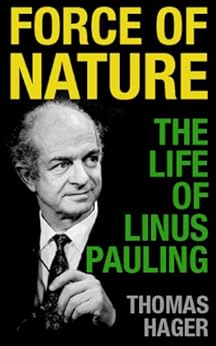
Book: Force of Nature: The Life of Linus Pauling

When I read Linus Pauling and the Chemistry of Life, I said it was the best biography of his. I didn't know that the same author wrote even a better one. In fact Linus Pauling and the Chemistry of Life is more like a summary of this book (700 pages vs. 140 pages). 

Tom Hager did a really good job in explaining Pauling's contributions to chemistry and medicine. He was a man full of ideas and a will to try to execute them. A career full of success.

You can read the book on Kindle for free too!

https://images-na.ssl-images-amazon.com/images/I/51Znr2F3d6L._SY346_.jpg

Friday, March 25, 2016

A brief history of cancer: Age-old milestones underlying our current knowledge database #chempaperaday 264

Cancer is not a new disease. It's been around since life on earth started. I found this Minireview very useful, and it can definitely be used as a source by following the works cited. The authors compiled several early examples of cancer, and they provided us some writings from ancient philosopher/doctors about the disease. The really frustrating part is that for some types of cancer we are not in a much different situation than that of those ancient doctors. 

In the end of the article, there is also a nice timeline of cancer with "milestones".

http://onlinelibrary.wiley.com/doi/10.1002/ijc.29134/full

Thursday, September 24, 2015

Cellular interactions of platinum drugs #chempaperaday 232

This is a 2012 review paper and a really good summary on the fate of platinum drugs in model systems and in cells. 


While we know that cisplatin completely cures testicular cancer and is very effective in a few other cancer types, the mechanism of action is still not really known. It is also not known why it is so selective against testicular cancer. The article made me really realize how little we know about cisplatin and other platinum anticancer drugs. There are tens of cellular targets and it is still not understood what happens to cisplatin when it enters the cell. In fact, only 1% of cisplatin ends up binding to DNA. There is still so much work to do to answer these questions and develop better drugs. I hope I can help one day.


Monday, September 21, 2015

The Phenomenon of the Styrian Arsenic Eaters... #chempaperaday 231

This is new to me. So, apparently, it was long known (or believed) to be that there were/are people who eat white arsenic to become immune to certain diseases or to get healthier! Stories of these people were told in several parts of the world including Europe and several novels, poems etc. are based on these people.


In this interesting article, you can read whether this phenomenon is real or not. The author mentions as many of these literature examples as possible and like a detective, he tries to find the truth. I think it is a really good read if you enjoy history of chemistry.

Friday, May 1, 2015

Third row transition metals for the treatment of cancer #chempaper 215

Among the metal based anticancer complexes, third row metal-based ones are the most common. In fact, Pt-based ones like cisplatin, carboplatin, oxaliplatin are really effective anticancer drugs. In this article, the authors summarize the mechanism of "classical" Pt-based anticancer complexes and briefly talk about the new "monofunctional" complexes (pyriplatin, phenanthriplatin). These are Pt complexes with a net + charge and they are trying to exploit the organic cation transporters. Finally, there are a few examples of really active Os(VI) based complexes.


Wednesday, October 8, 2014

Male breast cancer

Here is a very short and informative review about male breast cancer. There is for sure a lot to learn from this rare disease and it will definitely help to understand female  breast cancer.

www.nature.com/nrc/journal/v14/n10/full/nrc3806.html

Monday, January 20, 2014

#chempaperaday Day 4/365: "Interaction of Antidiabetic Vanadium Compounds with Hemoglobin and Red Blood Cells and Their Distribution between Plasma and Erythrocytes"

Today I read this very new paper about Antidiabetic Vanadium complexes and their binding to hemoglobin and interaction with red blood cells. Obviously, there are many parts that I couldn't really understand such as DFT calculations. So, I skipped that part and a few other paragraphs. But, overall I enjoyed it.